Tony Gilroy's "Behemoth!" opened at the New York Film Festival with its music doing something films almost never do: nine composers, nine distinct voices, one score. The film, written and directed by Gilroy and starring Pedro Pascal as a cellist named Alex who returns to Los Angeles after a life on the road, reaches theaters Dec. 4. According to Variety, Gilroy assembled Michael Abels, Emily Bear, Lukas Frank, Michael Giacchino, James Newton Howard, Henry Jackman, Nami Melumad, Brandon Roberts and Alan Silvestri — a group called the Behemoth Collective — to write the cues for the fictional films Alex works on within the story.
That structure is the point of the film, and it is what makes the behemoth score worth studying rather than just reporting. Music serves as the storytelling device: Alex's performances, on stage or on films he worked on, trigger flashbacks that reveal why he left Hollywood and what brought him back. Instead of one composer carrying that arc, Gilroy treated scoring like casting. "I knew I had to have different voices, and once you're going to open it up, you want to cast it like actors," he told Variety. The result is a film where the score's variety is not decoration — it is the plot's grammar. This connects to our earlier piece, The Vault Opens: why soundtrack box sets keep finding lost film music. Readers following this should also see The Vault Opens: why soundtrack box sets keep finding lost film music.
The news matters for a second reason, too. A major studio-adjacent film premiered at Lincoln Center's Tully Hall, a venue Variety noted seemed fitting for a story about a musician, and its central creative gamble was musical. For anyone tracking how scoring is discussed and marketed, this is one to watch. It also fits a broader pattern this year, in which soundtrack news has increasingly been about how scores get made, not just who gets hired.
Why nine composers instead of one?
Gilroy's answer, as he gave it to Variety, is that the film-within-the-film structure demanded it. He wrote backstories for all the fictional shows Alex works on, so each composer received a full plot for their cue. "I made backstories for all the shows, so all the shows have a story to them and I could tell all the composers what the plots of their show were," he explained. Henry Jackman was the first to come aboard, and Gilroy credits his enthusiasm with keeping the project moving. He knew he wanted Michael Giacchino for the cartoon cue and planned to bring Brandon Roberts back from the start.
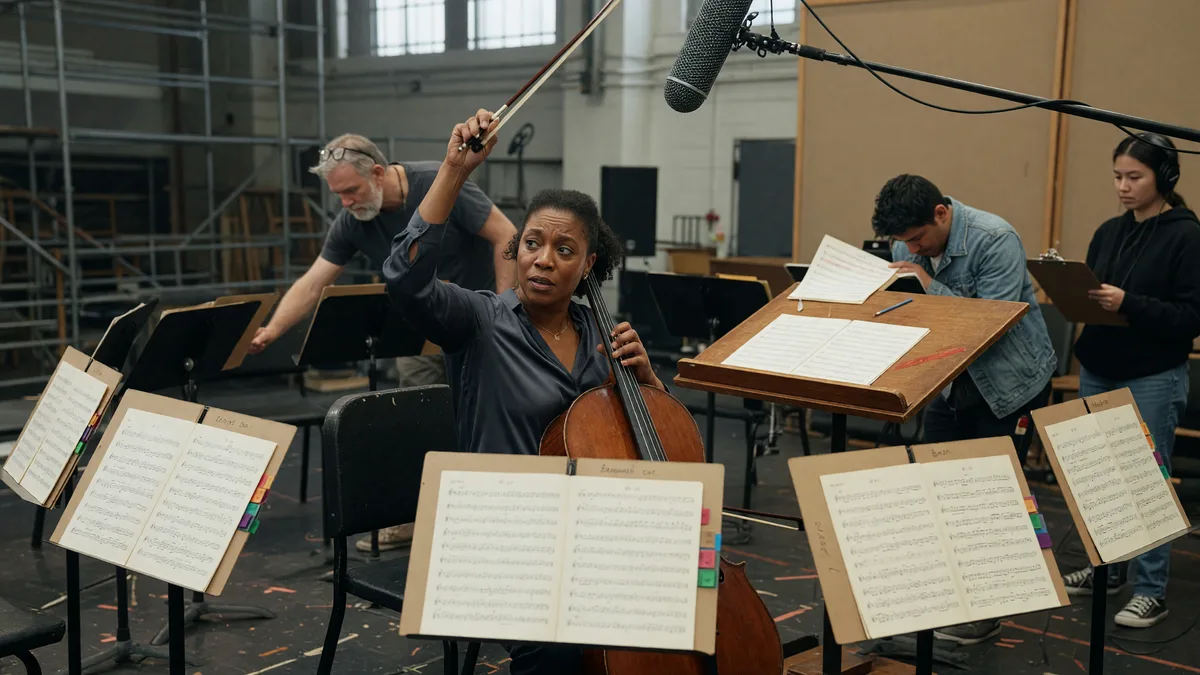
The deeper logic sits in the film's setting. Gilroy described sitting with the idea for years, dating it to his first visits to the John Williams Scoring Stage. "You get in there, and there's the emotional power and the smell of that room," he told Variety. "It's such a place of work, and then this incredible magic thing happens and there's no place for the music to go except into the microphones and into your ears. It can't escape that room." A film about the art of scoring, he concluded, needed the sound of many hands, not one signature.
How the cues map onto the story
The assignments read like a deliberate spread across film-music traditions, and each composer's account to Variety shows how tightly the cues are tied to Alex's life.
- Michael Abels scored Alex's solo cello practice sessions, including a scene where the music morphs from a warm-up exercise into Bach's Cello Prelude No. 1 — performed in a flashback by Alex as a six-year-old prodigy on "The Tonight Show with Johnny Carson."
- Emily Bear wrote the love theme for the fictional "Season of Glass," inspired, she said, by French and Italian film scores of the 1960s — lush strings, jazz-inspired progressions in an orchestral setting — plus a tentative waltz for a scene where a young widow teaches a boy to dance, built with counterpoint and chromatic detail underneath.
- Lukas Frank wrote the original song "Your God Is Sleeping" and the "Serian Suite," the underscore that recurs throughout the film, built around a prepared piano with a string drilled to make a low droning sound. The movie opens, he said, with the sound of the pedal coming down off the piano, followed by simple strings.
- Michael Giacchino wrote the cue for "Happy & Slappy," a 1960s cartoon Alex's father composed for, in a "Tom and Jerry" vein — music that syncs humorously with a scene of Alex watching his brother fight.
- Henry Jackman scored "Spies Don't Run" as a six-minute suite: orchestra, slightly abstracted vocals, heavy percussion, and what he called a slightly "Jason Bourne-ish" sound with a Middle Eastern flavor.
- Nami Melumad wrote the cue for "Tolerance Hill," a period film within the story that also has to carry Alex emotionally as he revisits his childhood home. She chose the harp — the instrument Alex's mother played — and called the result very delicate.
- James Newton Howard composed the finale: pure underscore, a solo piano expressing the story's sadness, which he also built into piano-and-cello duet and orchestral variations.
Read together, the cues form a map of Alex's life — childhood, family, love, loss — each rendered in a different composer's dialect. That is the analytical heart of the film's structure: the fictional films are not set dressing, they are the chapters of a biography told through scoring styles.
What it means for the scoring trade
A one-off experiment would be a curiosity. The more interesting question is whether the collective model travels. Gilroy's method — full fictional backstories handed to each composer, then casting voices to match — is essentially the commissioning process of a compilation album applied to a narrative feature. It asks composers to write character, not just mood, and it gives each a contained brief rather than a whole-film mandate. For a trade built around single-author scores and the awards recognition that follows them, that is a genuine structural alternative, and Variety's decision to devote a full composer-by-composer guide to the film signals how much attention the approach is drawing.
It also connects to a question this site has tracked before: how a score earns recognition when its authorship is distributed. The rules for how a film score earns its Oscar nomination assume a coherent body of music; a nine-voice score tests that assumption in public. Readers following this should also see The Thirty-Five Percent Rule: how a film score earns its Oscar nomination. This connects to our earlier piece, The Thirty-Five Percent Rule: how a film score earns its Oscar nomination.
What to watch next
The film reaches theaters Dec. 4, and much remains unknown from the available reporting: how the cues are sequenced and blended in the final cut, whether a soundtrack album gathers the collective's work, and how the Silvestri and Roberts contributions function — Variety reported speaking with all nine composers to break down their cues. What the evidence does establish is the shape of the experiment: a director who spent years wondering why nobody made a movie about the scoring stage, and who answered by hiring the room's worth of voices to make it with him.