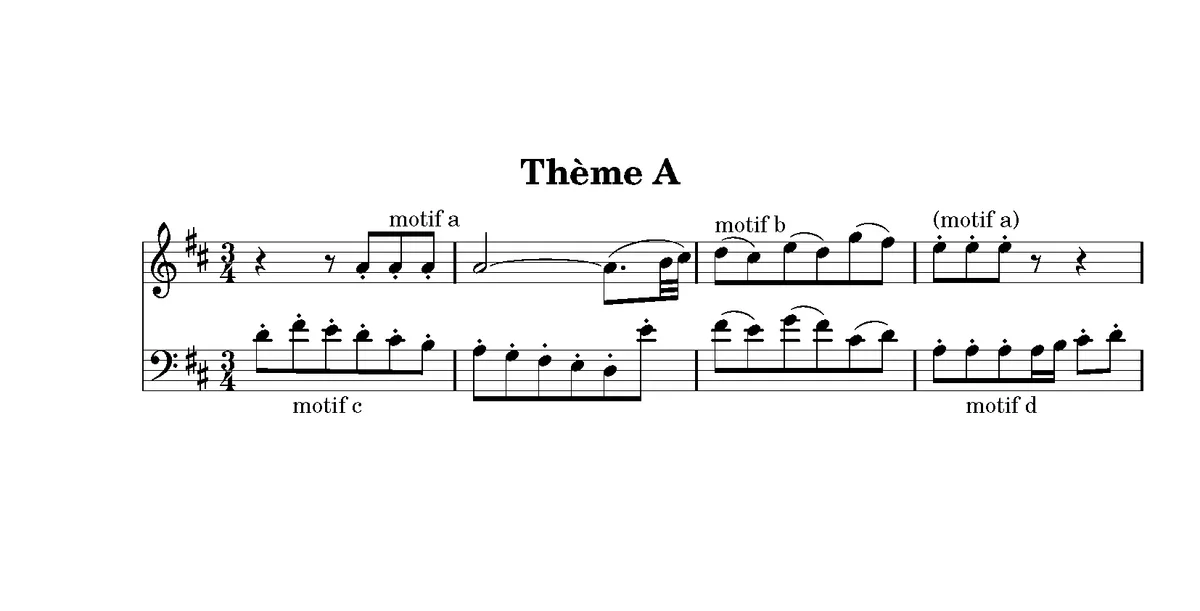
A musical motif is a short, recognizable phrase — often just two or three notes — that a composer attaches to a character, an object, or an idea, and then repeats and reshapes as the story moves. The audience rarely names it, hums it back, or notices it arriving. It simply works: the villain's arrival feels heavier, the lost object feels closer, the reunion feels earned, and almost nobody in the theater can say why.
That invisibility is the point. A motif is information delivered under the threshold of attention, plot data smuggled in through the ear. This piece looks at how these small phrases are built, how they transform across a score, and why listeners absorb them without ever registering that they have been told anything at all.
What exactly is a motif, and how small can it be?
A motif is the smallest unit of musical narrative that still means something. A single note can carry mood, but it cannot carry identity. Add a second note — especially one that moves in a distinctive way, low to high, or creeping half a step at a time — and the ear starts to pattern-match. Add a third, and the phrase becomes a signature. Composers working in the tradition of the leitmotif, the recurring theme tied to a person or idea, have long relied on this economy: the motif does not need to be a melody. It needs only to be unmistakable when it returns.
Smallness is a feature, not a limitation. A long, shapely theme demands the foreground; a two-note figure can sit under dialogue, under sound effects, under a scene the viewer is watching closely, and still do its work. The most famous suspense figures in film music are famously terse for exactly this reason — they fit in the gaps of a scene rather than filling it. The motif's job is to be present without being the main event.
How does a motif encode a character or idea?
The encoding happens through association. The first time the phrase sounds, it coincides with the character on screen or the idea in the libretto. The second time, the association is already half-formed. By the third, the phrase can appear without its owner — an empty room, a closed door, a name spoken aloud — and the listener supplies the missing presence. The motif has become a name in a language the audience never agreed to learn.
Composers choose the raw materials with care, because the sound itself does some of the naming. A rising figure can suggest aspiration or threat depending on its intervals and instrumentation. A dark instrumental color can attach suspicion to a character before that character does anything suspicious. Harmony, too, carries identity: as explored in Chords as Characters: how harmony signals who is on screen, the chords under a figure can signal who a person is before a word is spoken. The motif is not a label pasted on; it is a bundle of musical choices that happen to mean the same thing the story means.
Why do listeners absorb it without noticing?
Hearing is an involuntary sense. Vision can look away; the ear cannot close. Music playing under a scene reaches the listener whether or not the listener is paying attention, and repetition does the rest. Each return of the phrase deepens the groove, and because the returns are spaced across a whole film or show, no single appearance feels like an event. The information accumulates in the background, the way a face becomes familiar from passing someone in the hallway every day.
This is also why the motif differs from an obvious song. When a full song plays, the audience knows it is being addressed; the lyrics make claims, and the listener can accept or resist them. A motif makes no claims. It never argues, never explains itself, and asks for nothing. That is precisely why its information lands as feeling rather than as message — the audience experiences recognition without being able to locate its source. The related mechanics of bare repetition, stripped of narrative attachment, are the subject of The Note That Returns: how musical repetition builds feeling.
How does a motif transform as the story turns?
Transformation is where the motif earns its keep. A phrase introduced confidently can return fragmented, played slowly, or stripped of its warm instrumentation when the character it names is broken. The same notes, inverted or shifted into a minor coloring, tell the audience that the thing they associated with safety has changed — without a line of dialogue, without a caption, without anything the eye can catch. The listener feels the plot turn before seeing it, which is the quiet promise of the craft.
The transformations follow the story's own grammar. A motif can grow fuller as a character gains power, thin out as that character is isolated, or collide with an opposing motif when two forces meet, the way contrapuntal writing lets two themes argue in the same bar. Some composers withhold resolution deliberately: the habit of leaving a theme unresolved, and what that withholding does to an audience, is examined in The Door Left Open: why film themes never resolve. An unresolved motif keeps a question alive in the ear long after the scene has cut away.
Stage music works the same way, and the evidence is built into the form itself. According to Wikipedia's overview of musical theatre, a book musical is usually built around four to six main theme tunes that are reprised later in the show, with the second act typically containing reprises of important musical themes as the conflict resolves. In other words, the reprise is not decoration; it is the standard machinery by which a stage story reminds its audience what mattered, using melodies already planted in the first act. The same source notes that moments of greatest dramatic intensity in a book musical are often performed in song — the theme returns exactly when the story has earned its weight.
What this means for listeners and writers
For listeners, the practical step is simple: on a rewatch or relisten, follow one phrase instead of the plot. Pick the figure that seems attached to one person or one question, and track where it appears, what instrument carries it, and what has changed since last time. What looked like background music resolves into a second narration running parallel to the visible one.
For writers and composers, the lesson is about restraint. A motif works because it is small, consistent, and transformed with purpose; diluted across too many ideas, it becomes wallpaper. The craft sits in deciding what the few notes mean, planting them clearly once, and then spending them sparingly — a discipline of information, not of melody. The wider toolkit of musical narrative, from ballad structure to point of view, is gathered in the site's storytelling coverage, and the historical sweep of the theme-as-name idea runs through The Theme That Follows You Home: How the Leitmotif Took Over Film Music.
Where the small phrase ends up
The strangest fact about the motif is its afterlife. Long-running stage works keep their themes alive for decades of performances — the Phantom of the Opera has been performed on Broadway more times than any other production, a longevity documented in Ranker's ranking of the most popular Broadway musicals — and each performance re-teaches the audience the same small phrases. A motif outlives the scene that introduced it, the production that staged it, sometimes the century that first heard it. Two or three notes, repeated with intent, turn out to be enough to carry a whole story — and to keep carrying it for anyone willing to listen, even once.