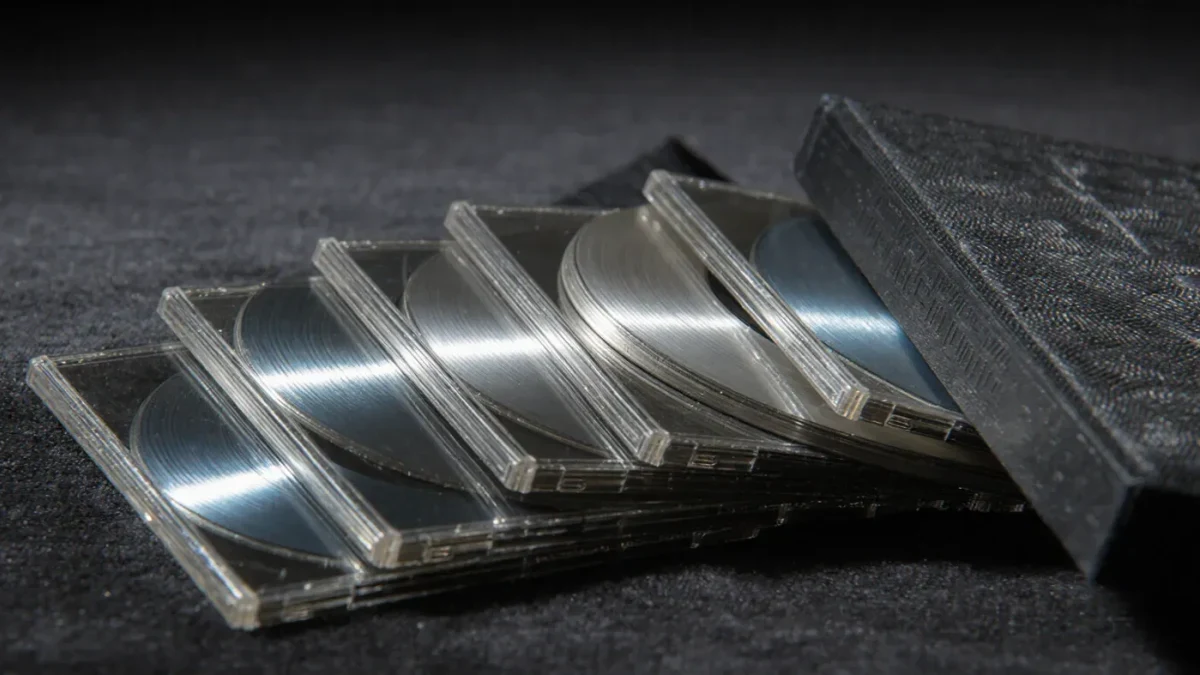
Archival soundtrack box sets exist because most film music has never been legally available at all. Varèse Sarabande, the label founded in 1978 that helped invent the modern score album, has released only a fraction of its vault on any format, and specialty labels such as Intrada and La-La Land Records build their calendars around recovering the rest. Each announcement of a new box set is therefore a small archival event: music that sat in a studio vault for decades suddenly has a disc count, a remastering credit and a street date.
Storybook Strings publishes information about this craft, not purchasing advice; edition sizes and availability change without notice, and the labels' own pages control.
What actually sits in a studio vault?
Film scores are recorded in multitrack sessions, then mixed down for the film itself. What survives varies wildly: some studios kept the original multitrack tapes, some kept only the music stems, some kept nothing but the final printmaster, and some lost material to fire, neglect or plain housekeeping. A box set producer's first job is an inventory — establishing which elements still exist before anyone promises a "complete score."
The famous cases set the expectations for everything since. When the original Star Wars tapes were prepared for expanded releases in the 1990s and 2000s, the label work demonstrated both the promise and the friction of vault projects: music could be restored that had never aired anywhere, but damaged tape, missing cue sheets and unclear ownership could stall a project for years. Every specialty label since has worked inside those constraints.
How does a box set actually get made?
The pipeline runs in recognizable stages, and understanding them explains why announcements cluster and slip. It begins with licensing — the label negotiates with the studio that owns the recordings, the music publisher that owns the composition, and sometimes the composer's estate. Then come the tapes themselves, which are baked, transferred at high resolution, and restored. A producer assembles the program: the film versions, the alternate takes, the source music. Mastering follows, then liner notes, artwork, and a manufacturing run that is almost always deliberately small.
- Licensing: the slowest stage, invisible to fans, and the reason a rumored title can sit unannounced for years.
- Transfer and restoration: analog tape is physically baked to counteract binder breakdown, then played back once, carefully.
- Assembly: the producer decides what a "complete" edition means — film cues, album assembly, alternates, outtakes.
- Mastering and notes: the scholarly layer, where cue titles and session dates are reconstructed from paperwork.
Why are the pressings limited?
Because the license is limited. Soundtrack reissue deals typically grant a label a fixed window — often around three to five years — and a capped unit count for physical product. A pressing of two or three thousand copies is not scarcity marketing; it is the shape of the contract. When a sellout title goes out of print and secondhand prices climb, that is the license expiring, not the label withholding stock.
That structure also explains the rhythm of announcements collectors know well. Labels tease titles at anniversary moments and fan conventions, confirm street dates late, and occasionally pull a project when a rights holder balks at the final paperwork. A 2026 box set announcement calendar read without that context looks chaotic; read with it, the pattern is simply what niche licensing looks like from the outside.
Who are the labels to know?
A handful of specialty houses dominate the archival field, and their founding dates trace the whole history of the format.
| Label | Founded | Known for |
|---|---|---|
| Varèse Sarabande | 1978 | The catalog that built the score-album market, now itself a reissue target |
| Film Score Monthly | 1990 | Started as a fanzine; its CD line defined the golden-age box set |
| Intrada | 1985 | Long-running archival program, including major studio licenses |
| La-La Land Records | 2002 | Expanded and complete editions of studio-era and modern scores |
Alongside them sit Quartet Records, Kritzerland, BuySoundtrax and others, each with its own licensing relationships. For a newcomer, the practical entry point is not a specific box but a composer: pick one, follow the label that holds that catalog, and the announcement cadence teaches the rest.
What changes when archives go digital?
Streaming has made some of this material easier to hear and none of it easier to license. Digital releases dodge the manufacturing cap but not the rights negotiations, which is why famous scores remain unavailable on streaming services while their CD editions sell out in days. Meanwhile, institutions have been doing parallel work at the historical end: the Library of Congress's National Jukebox streams early commercial recordings from the acoustic era, free, as part of the library's recorded-sound preservation mandate — a reminder that score recovery is one branch of a larger recorded-sound preservation effort.
That is the quiet through-line of every box set announcement. Behind the disc counts and the limited-edition stickers is preservation work: tapes that exist in one copy, session logs that exist nowhere else, and a handful of labels still willing to pay for the labor of turning them into product. The announcements of 2026, whenever they land, will be the visible edge of that work — a vault door opening a few inches at a time.
Why do fans wait years for a single title?
Because every stage of the pipeline can stall independently, and the stalls are usually silent. A rights holder may sit on a signature for eighteen months. A tape element may turn out to be damaged beyond baking, forcing the producer to rebuild a cue from stems. A composer's approval — contractually required on many reissues — may simply take time. None of this reaches the forums until the label can announce a date, which is why collector communities read teases, silences and convention-table hints the way weather readers read clouds.
The waiting has a productive side. Long-gestating projects tend to arrive with the deepest scholarship: session dates matched against orchestra contracts, cue titles reconstructed from part covers, alternate takes placed in the order the composer auditioned them. The 1990s and 2000s golden-age editions built that template, and the current generation of producers inherited both its standards and its archival patience. A box set that takes five years to appear frequently carries five years of paperwork in its liner notes — the quiet justification for the wait.
What should a newcomer listen for?
The rewarding entry point is a single film handled two ways: the original album assembly and a later complete edition of the same score. Hearing both side by side teaches what reissue producers actually do. The album version is sequenced for listening, its cues edited and ordered for flow; the complete edition restores the film's running order, with cues in dramaturgical sequence and every seam showing. The gap between the two is the craft — the difference between music packaged as a record and music documented as a score. From there the catalog opens outward: one label, one composer, one decade of studio history at a time.