Score restoration is the work of finding a film's original recordings, transferring them before the tape decays, and rebuilding the complete music that studios once shortened or scattered. It has been a going concern since Varèse Sarabande, founded in 1978, proved a market existed for soundtrack albums beyond the original LP release.
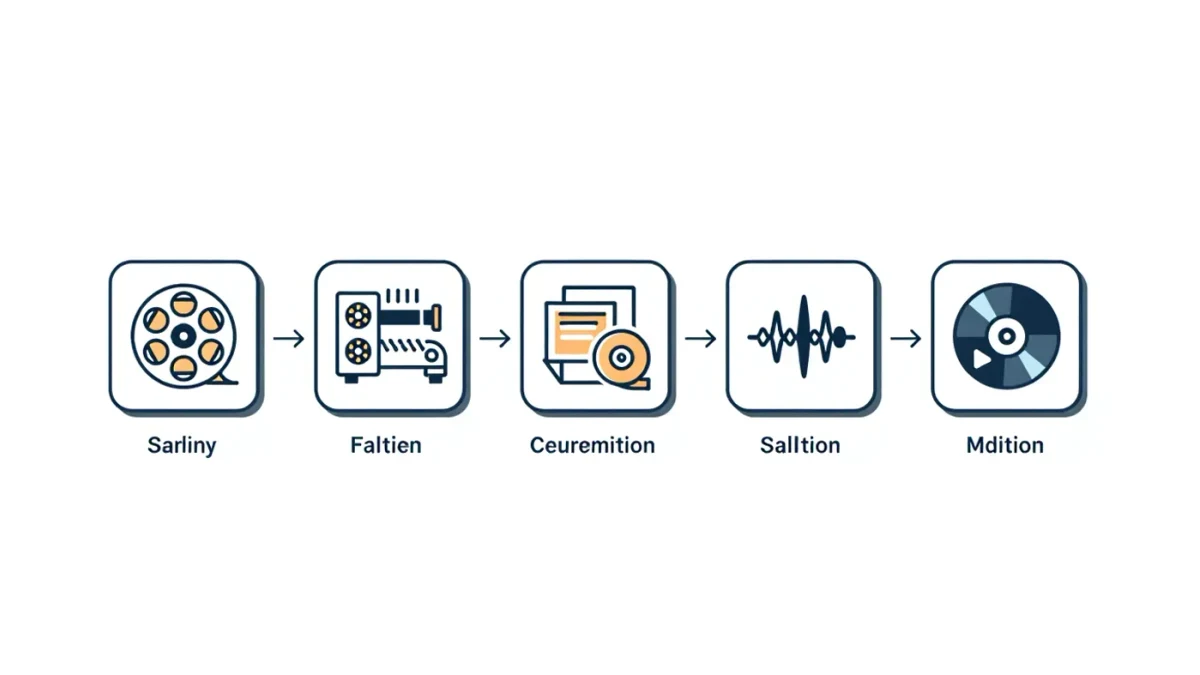
Reissue headlines tend to name the labels and the films, but the real story is the pipeline underneath: vault retrieval, tape repair, transfer, editing against the surviving cue sheets, mastering, and a small manufactured run. Each stage has its own craft, and each is where a restoration can succeed or quietly fail.
What happens to the tapes first?
Most classic film scores survive on magnetic media that is now itself the patient: quarter-inch tape, multitrack session rolls, and 35mm magnetic film stock. Age is the enemy in two forms. Physical decay — sticky-shed syndrome, where a tape's binder absorbs moisture and squeals against the playback head — is treated by carefully baking the tape at low heat, a standard conservation practice that makes a single clean transfer possible. Obsolescence is the second threat: the machines that play odd formats are aging out of existence faster than the tapes themselves, which turns every working deck into conservation equipment.
The rule that follows from both threats is simple and unforgiving: every playing of an original tape is a risk, so the transfer has to be right the first time. Restorers therefore prioritize the earliest generation available — the session masters rather than the mixed album reels — because each earlier generation carries more of what the engineers actually recorded.
Who does the restoring?
A small specialty-label ecosystem does most of it. Varèse Sarabande, founded in 1978, built the market with soundtrack releases and later expanded older titles. The Film Score Monthly label's compact disc series, run from the mid-1990s by Lukas Kendall, opened the MGM vaults and made complete scores of studio-era films available to collectors for the first time. Intrada, founded in 1985, has likewise specialized in expanded and restored editions of rare scores. Quartet Records, based in Madrid, has become the field's international arm, and Intrada also retails its titles in the United States.
These labels operate under licenses from the studios that own the recordings, which is why a sought-after restoration can disappear for years and return without warning: the rights, not the tapes, are usually the bottleneck.
Why do scores need restoring at all?
Three historical accidents did the damage. Album length was the first: the vinyl LP held roughly forty minutes, so score albums of the LP era were routinely abridged to a highlights program, and the unreleased cues stayed in the vault. Library practice was the second: tapes were cataloged inconsistently, moved between facilities, and sometimes junked, so the physical whereabouts of a complete score is genuinely uncertain until someone looks. Fire was the third and cruellest: a 2008 vault fire at Universal destroyed master recordings stored on the lot, a loss whose full extent became public reporting in 2019 — a reminder that irreplaceable tapes can burn before anyone thinks to transfer them.
Restoration reverses what the accidents left behind, where the material survives. Against the abridged LP, the restorer assembles the complete score from session takes; against bad cataloging, patient archival search; against fire, nothing at all — which is part of why the surviving vaults are treated with such care.
What can go wrong in a restoration?
Plenty, and the failure modes are instructive. Transfer introduces its own hazards: a tape played at the wrong speed shifts pitch audibly, and a machine calibrated incorrectly can imprint its own wobble onto the only clean pass a tape will ever give. Damage forces judgment calls — a splice that fails mid-take, oxide flaking from a cherished reel — and the restorer must decide between repairing the take, substituting an alternate, or printing the gap and documenting it honestly in the notes.
Assembly raises second questions. Cue sheets survive unevenly, film stems may be missing, and the order of takes is not always the order heard in the picture, so reconstructing the score as the composer meant it can conflict with reconstructing it as the audience heard it. The respected editions state which goal they pursued, and where they guessed. An edition that explains its choices is asking to be trusted; one that stays silent is asking to be doubted.
How do restored scores reach listeners now?
The release model has settled into a hybrid. Limited compact disc editions — often runs of one to three thousand copies, with the license structured accordingly — serve the collector market that funds the restoration, and the same transfers typically reach streaming services for everyone else. Vinyl reissues follow for titles with enough demand, and the specialty press tracks the whole pipeline: roundup columns such as The Second Disc's Soundtrack Watch catalog each month's announcements, including a December 2025 and January 2026 batch covered in the column's January 12, 2026 installment, which noted new limited editions including a thousand-copy two-disc presentation built from hi-res stereo transfers of a complete score and its original album.
For listeners the practical effect is that music which once existed only on decaying tape, or only in abridged form, is now a search away — and that the economics still depend on a few thousand people buying physical discs.
Vinyl adds a further wrinkle. A complete restoration can run ninety minutes or more, which the LP format cannot hold without the very abridgment the restoration undid, so vinyl editions of restored scores are usually programmed selections rather than the full assembly. Collectors increasingly hold both: the compact disc for the complete score and the record for the listening program. The object, in this corner of the market, is part of the argument for the music.
What is preserved beyond the music?
The cue sheets, the paperwork, and the stories. A restoration package typically documents which takes were used, where the tapes were found, and who mixed them decades apart — an accidental archive of production history that would otherwise evaporate. The institutional frame is growing alongside the labels: the United States Congress created the National Recording Preservation Board through the National Recording Preservation Act of 2000, and the Library of Congress issued its National Recording Preservation Plan in December 2012 to coordinate exactly this kind of work at scale.
The labels got there first, one license and one baked tape at a time. Every limited edition that sells out on announcement day — a routine event in this corner of the record business — is the market's way of saying the vaults still have more to give.