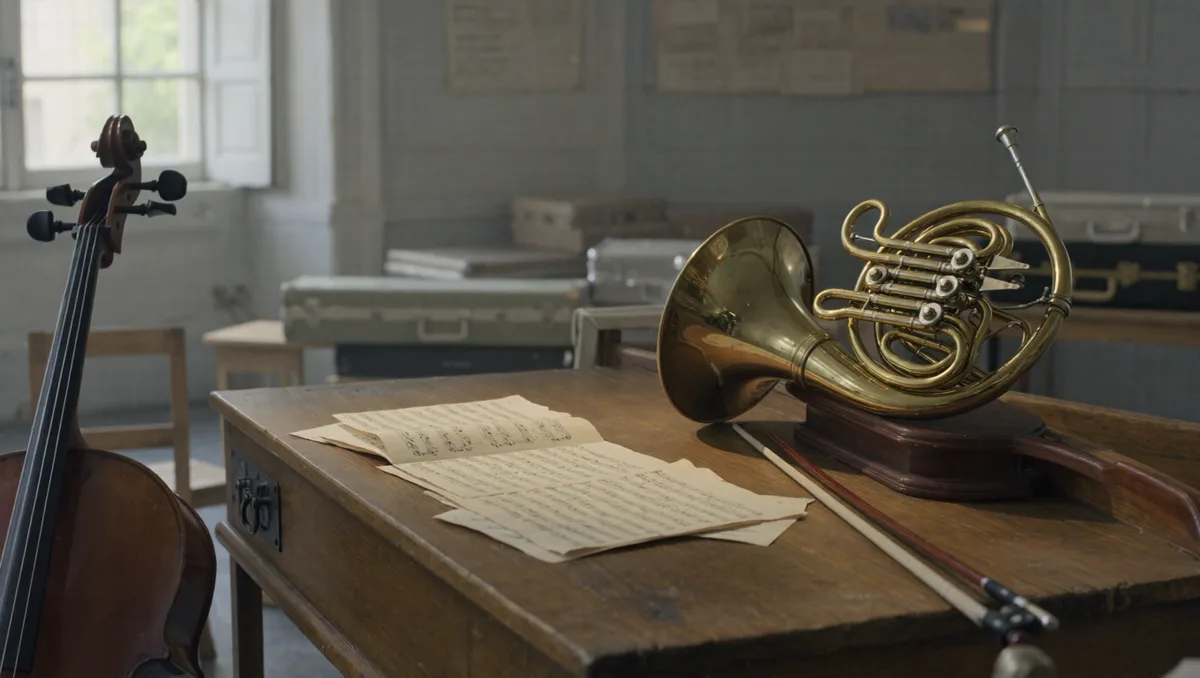
Silence in film scores is not the absence of storytelling. It is a choice a composer makes, cue by cue, about where music should stop — and the moment the music stops is often the moment the audience leans in. A score that runs wall to wall flattens everything; a score that knows when to hold back lets a single entrance land like a struck match. The craft question is never whether to use silence, but where.
That question gets decided early. At the spotting session — the meeting where director and composer decide which scenes get music — what is left out matters as much as what is cued. Every scene scored is a scene that cannot be scored differently, and every scene left bare becomes a container the audience fills with their own attention. A composer who cues everything has surrendered that container. A composer who rations it owns one of the most powerful tools in narrative sound.
This piece is about that rationing: how silence builds tension, how it marks character, and how it gives weight to the moments that follow it. It sits alongside the wider craft of musical storytelling covered across the site's narratives coverage, and it pairs naturally with the way composers plant material early for later payoff, the subject of The Motif That Waits: How Composers Plant Seeds for Later Payoff.
What does silence actually mean in a score?
It helps to be precise about the word. Merriam-Webster defines silence as "forbearance from speech or noise" and, in a second sense, "absence of sound or noise: stillness." In a film context, neither definition is literal. A scene without music is almost never without sound — dialogue, footsteps, room tone, wind. What the audience experiences as silence is the absence of the score, a forbearance from music rather than an absence of sound. That distinction is the whole trick. The composer has not removed sound from the scene; the composer has removed commentary.
Once framed that way, the device looks less like emptiness and more like punctuation. A cue tells the audience how to feel. A held silence tells the audience to feel for themselves, and most viewers, given the room, feel more.
Why does pulling the music build tension?
Tension in a score is usually described as a matter of addition: dissonance added, tempo raised, brass stacked. But subtraction does the same work with a different mechanism. Music on a soundtrack functions as a signal that the film is guiding the viewer; when that signal cuts out, the viewer loses the guide and has to watch harder. The scene becomes a room with the lights half off. Every creak and pause grows louder because nothing is competing with it.
There is a second, subtler mechanism. Audiences learn a film's grammar within minutes. If a thriller has been scored steadily, the sudden withdrawal of music reads as a warning — the same way a horror film that goes quiet before the door opens has taught the viewer that quiet means danger. The silence inherits meaning from the music around it. A composer who has scored generously has, in effect, been training the audience for the moment the score disappears.
How does quiet mark a character's emotional state?
Sparse instrumentation works on the same principle at a smaller scale. A cue reduced to a single held note, or a lone instrument over silence, isolates a character the way a spotlight isolates an actor. The texture itself becomes the statement: one voice in a wide space is loneliness you can hear. When the arrangement swells back, the return of fullness reads as connection, relief, or threat depending on what the harmony does — and the contrast between the two states is where the emotion lives. Neither state would register without the other.
What this means in practice is that the composer is writing with two materials, not one. The score and the gaps between cues form a single continuous line, the way a sculptor's voids are part of the form. A composer who thinks only in notes is working with half the palette.
Where did this idea come from?
The instinct to structure sound around stillness long predates cinema. Radio drama, which had no image at all, built entire narratives out of the alternation between music, effects, and dead air — a tradition examined in Theatre of the Ear: how music and sound design carried radio drama before television. With nothing to look at, the pause became a dramatic beat in its own right: a silence after a confession on air could hold a whole room of listeners. Screen composers inherited a grammar that radio had already proven.
The lineage runs deeper still. Programmatic concert music — instrumental music written to carry a story, the subject of The Programme in the Pamphlet: where program music began — already understood that a narrative needs breathing space between its episodes. The rest, in the musical sense, was always part of the composition. Film scoring did not invent the idea; it industrialized it, applying a nineteenth-century insight to a twenty-four-frames-per-second machine.
Why doesn't silence work in every scene?
Because silence is a bet on the audience, and the bet can lose. A bare scene asks the viewer to supply engagement; if the writing or the performance does not hold them, the emptiness reads as dullness rather than dread. Silence also loses power through overuse. A film that keeps going quiet stops making quiet mean anything — the audience adjusts, the way ears adjust to a loud room. The device only works while it stays scarce.
There is an economic angle worth naming honestly, since scoring is a business as well as an art. Music is the part of a soundtrack that gets licensed, streamed, and sold; quiet is the part that earns nothing. A composer under pressure to deliver a marketable album has an incentive to keep the score dense. The best practitioners resist that pressure, because the record and the film are different objects — a distinction explored in The Score and the Songs: How One Soundtrack Won Two Grammys. What plays well as an album can weaken the film it came from, and the gaps are usually the first casualty.
What should a listener take from this?
The evidence points to one conclusion: silence in a score is active, authored, and load-bearing. It is chosen at the spotting session, trained into the audience by the music that surrounds it, and spent — deliberately — on the scenes that need the viewer's undivided attention. What remains unknown in any given film is the composer's private reasoning; unless a composer has documented why a scene was left bare, the honest reading is of the effect on screen, not the intent behind it.
So the next time a scene grips you with nothing playing over it, treat the quiet as a cue in its own right. Someone decided it should be there. The room went still because a composer, weighing every scene in the film, judged that this one would move you most with the music gone.
Sources: merriam-webster.com