Podcast scoring is the craft of composing music for a story told entirely in sound, and because nothing competes for the listener's eye, it runs by different rules from film work. Gimlet Media's 2016 fiction series Homecoming arrived with an original score; the BBC's Joni Mitchell docuseries pairs archive and narration with composed music. The craft is the subject here.
A note on terms: a score is music written for a specific narrative work, as distinct from licensed songs chosen after the fact. In podcasting the two get blended constantly, and the line matters less than the function. This piece discusses composed score.
Why does a story told in sound need music at all?
Because audio has no establishing shot. A listener who cannot see a city skyline, a shabby office or a dark road needs a signal about where the story stands, and music supplies it faster than narration can. A bed of low strings places a scene at night; a bright repeating figure says the plot has moved forward; a sudden silence says something has gone wrong. Speech carries the information, but music carries the weather around it.
The comparison listeners half-remember is radio drama, which solved the same problem with organ swells and boxing-bell sound effects for decades. The serialized podcast inherited that toolkit and made it smaller and quieter. Where a 1940s broadcast announced its transitions, a modern scored podcast usually smuggles them past the listener — a two-second figure under the host's last sentence, a held chord as a scene changes.
How does music structure an episode without pictures?
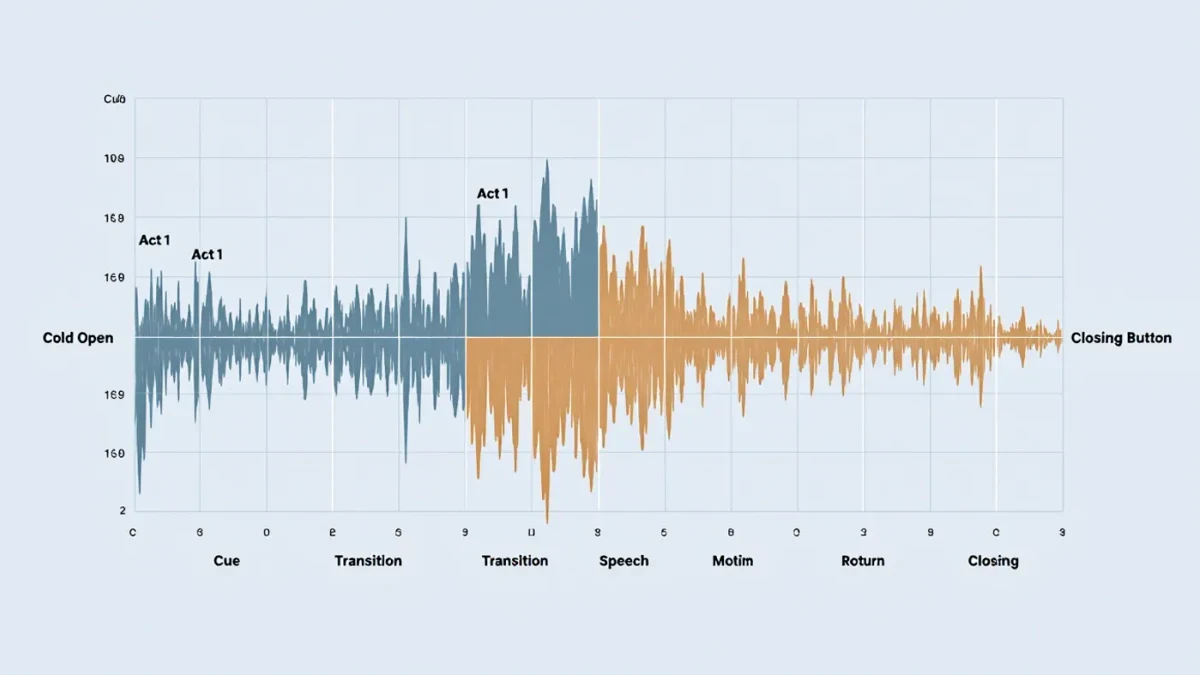
Most longform episodes are cut into acts, whether or not anyone announces them, and the score is what draws the walls. Composers and producers working in the form describe a recurring set of jobs: an opening that promises a mood before the first word, act transitions that reset attention, a sting that marks a revelation, and a closing figure that lets a chapter down gently. The music functions as punctuation that the ear parses without ever being asked to.
- The cold-open cue — sets tone under the teaser, often the most composed moment of the episode.
- Transition beds — short repeating figures that carry the listener between scenes or interview subjects.
- The underscore — low, deliberately uninteresting music that sits under difficult tape so the voice stays central.
- The button — a final chord or figure that closes the act, the audio equivalent of a fade to black.
The craft discipline is restraint. An episode of a daily news podcast may run scored music for well under a tenth of its length; a scripted fiction series may score almost every minute, but at levels a film composer would consider a whisper. Loudness is the one card audio drama cannot play for long, because the listening situation — headphones on a commute, a speaker in a kitchen — punishes anything that shoves the voice aside.
What changes when a story runs for a whole season?
Repetition starts to mean something. A figure heard once is decoration; the same figure heard in episode one and episode eight is a memory, and the listener does the work of connecting them. Serialized audio exploits this more directly than film, where a two-hour running limit compresses how far a motif can travel. A season is long enough for a theme to age — introduced under a hopeful scene, returned to later in a thinner arrangement, so the same notes now read as loss.
This is the leitmotif principle, a recurring musical phrase attached to a person or idea, borrowed from opera and film, but podcast seasons give it room that cinema rarely affords. A character who exists across ten episodes can be traced musically: the slightly wrong-sounding chord under an unreliable narrator, the warm mode that returns whenever a particular place enters the story. Because there is no image to confirm identity, that musical tag does real narrative work — it tells the listener who is present before anyone speaks.
Homecoming remains the early landmark for this. Its 2016 episodes used a composed score the way a thriller film would — to pace scenes, to seed unease, to give an institutional setting a sonic identity — and the series was adapted into a television drama in 2018, a rare crossing from podcast scoring to screen scoring. The adaptation had to add what audio never needed to show: faces, rooms, a visual world that the music had previously been asked to imply alone.
Where does the music sit in the mix?
Underneath, and specifically. Podcast mixing treats speech as the load-bearing element, and the score is carved around the frequencies where voices live. Composers working in the form write around the middle of the register, keep percussive attacks out of consonant-heavy passages, duck their beds the moment a new speaker starts, and reserve the full dynamic range for the moments between tape. It is closer to the discipline of a music editor than of a concert composer. A podcast score sits at levels that would read as inaudible on a film dub stage; the medium rewards placement over power.
Documentary series sharpen the ethical edge of this. Score can make a real person's testimony feel more ominous than it is, and producers argue openly about where underscoring interview audio becomes editorializing — music that tells the listener what to think about a sentence the subject never framed that way. The honest practice, where it is articulated, is to score the story's established facts and leave disputed tape bare.
What has the form learned from film — and what has it had to forget?
The useful inheritance is structural: act structure, motif logic, the habit of scoring intent rather than surface. What podcast scoring has had to abandon is spectacle. Film scores can afford grandeur because an orchestra of visuals holds the frame; audio alone converts grandeur into mush. The best work in the field tends to be small — a handful of instruments, often electronic, textures assembled by one composer working alone rather than an orchestra on a scoring stage. The BBC's in-house audio documentaries, with their original scores layered under archive tape, show how far a modest palette can go when it is placed precisely.
The deeper lesson cuts against habit. In a cinema the score can lean on the image; in headphones there is nothing to lean on, so every note makes a claim about the story. Composers in longform audio learn to make fewer claims and mean them — one figure placed at the right second, then silence. A story heard in the dark, with nothing to watch, turns out to be the strictest teacher of musical economy working today.