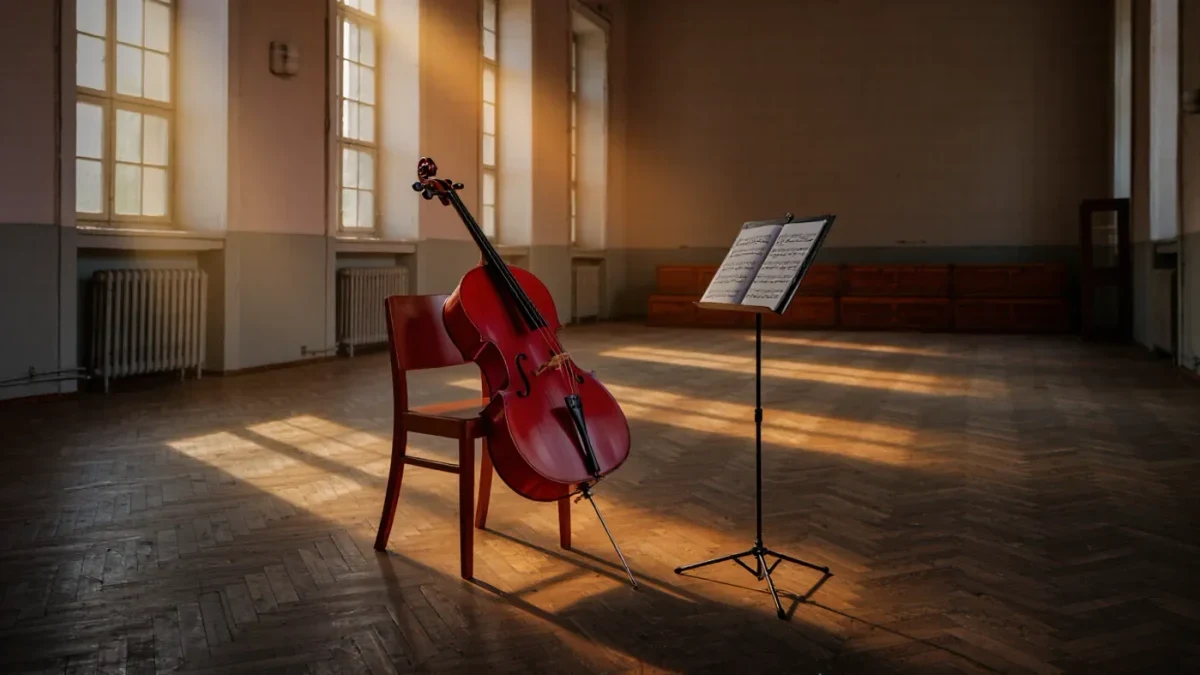
A suite is a sequence of instrumental movements, usually dances or character pieces, arranged so that their order implies travel — and it tells stories without singing a word. Johann Sebastian Bach's Cello Suites, BWV 1007–1012, composed around 1717–1723 at Köthen, run prelude, allemande, courante, sarabande, gigue in every one of six suites: same rooms, different light. That fixed order is the whole mechanism. Nothing is narrated, yet a listener who follows the sequence feels departure, arrival, reflection and exit — narrative produced purely by arrangement.
Where did the suite's order come from?
From the dance floor, which imposed dramaturgy before anyone called it that. The allemande walked with moderate steadiness, the courante quickened into flowing steps, the sarabande slowed to a weighted, ceremonial halt, and the gigue closed the set at a run. Composers inherited this sequence as a tempo and meter curve: four French dances in a fixed emotional gradient. By the time Bach wrote for solo cello, the dances were no longer meant for dancing — they were abstract pieces carrying the dance's character the way a novel carries the shape of a life without being a biography.
The baroque suite grew optional insertions between the sarabande and gigue — minuets, bourrées, gavottes, collectively the galanteries — which function like episodes inside a frame, and an opening prelude to establish key and atmosphere. Water Music, which Handel performed on the Thames for George I on 17 July 1717, was assembled in suites whose movements answered practical dramaturgy: music for arrival, for dining, for departure by barge.
How does order alone create narrative?
Through expectation and modification. A listener learns the pattern within one suite — say, the allemande's particular figure — and then hears each subsequent movement as a response to what came before. Because the sequence repeats across suites, the pattern itself becomes a form of plot: the sarabande lands as a climax of weight precisely because two faster movements preceded it. This is narrative without content, structure doing the work of story, and it is why suites survive transcription into any medium. The order, not the orchestration, is the argument.
Compare a novel's chapters: each is readable alone, but the sequence manufactures meaning that no chapter contains. A suite's movements were often written separately, performed separately, even published separately — and the composer or editor's act of arrangement is the compositional decision that makes the story exist.
When did suites start telling explicit stories?
In the nineteenth century, when program music — instrumental works claiming extra-musical subjects — folded narrative titles into the suite form. Edvard Grieg's two Peer Gynt suites are the canonical case: the incidental music he wrote in 1875 for Henrik Ibsen's play was refashioned in 1888 into Suite No. 1, Op. 46, with movements titled Morning Mood, The Death of Åse, Anitra's Dance and In the Hall of the Mountain King, followed by Suite No. 2, Op. 55, in 1891. Titled movements turn sequence into itinerary; the listener is no longer tracking tempo contrast but places and events.
Piotr Ilyich Tchaikovsky made the move in reverse order of premiere: the Nutcracker Suite, Op. 71a, reached concert audiences in 1892 before the ballet from which it was drawn, an eight-movement selection that had to stand alone as listening — and did, well enough that for many listeners the suite long outpaced the ballet in familiarity. Nikolai Rimsky-Korsakov's Scheherazade, Op. 35 (1888), titled its movements after the Arabian Nights tales while remaining thematic in method: the solo violin's recurring melody stands for the storyteller herself, a leitmotif avant la lettre binding the movements like a narrator.
What did film music inherit from the suite?
The extraction habit. When a film composer assembles a concert work from a score, the procedure is Grieg's: select, order, title, and thereby produce a listening piece with its own arc. The film-score suite — common on programs since the mid-twentieth century, and now standard at film-music concerts — assumes exactly what the baroque dance order proved, that sequence manufactures story even when the audience has not seen the source. A suite from a film score often plays better in the hall than a chronological cue run, because the arranger is composing order, not preserving it.
Television and game scores push the same logic further. Season-summary suites, promotional concert arrangements and soundtrack album sequences all rely on arrangement as narration — deciding what follows what, and therefore what it means.
Has the suite survived outside classical music?
It migrated into jazz, where Duke Ellington used suite-scale order to carry explicitly historical narratives. Black, Brown and Beige, which he introduced at Carnegie Hall on 23 January 1943, was billed as a tone parallel to the history of Black Americans, its three titled sections moving from slavery to the present of 1943 — suite structure pressed into documentary service, without a sung libretto to lean on. Later jazz suites, from extended big-band works to modal recordings organized as ordered tableaux, kept the same bargain: the movements stay instrumental, the story stays implied, and the arranger remains the narrator. Rock and progressive music took the term for side-long sequences, and soundtrack albums do the same work quietly every release week. The word has stretched, but the mechanism has not moved: order first, story second, words optional.
Why do listeners feel a story without words?
Because human listening treats succession as causation. Play two movements in one order and the second sounds like a consequence; reverse them and both change character. Composers of suites work with this reflex directly — the return of a slow movement after brilliance reads as reflection, a final fast movement as resolution or escape. The suite is the cleanest laboratory for this effect, since its materials are often too brief to develop symphonically; all the storytelling pressure falls on placement.
It is also the most portable. Bach's suites have been transcribed for lute, guitar, viola, trumpet and orchestra, and the story survives every transfer intact, because it was never in the timbre — it was in the order of the rooms. Readers who want to follow the paper trail can browse the Library of Congress digitized scores and libretti, where historical editions of exactly these works can be examined page by page.
How should a newcomer listen to a suite?
Listen twice, once for the gradient and once against it. On first hearing, follow the tempo curve — where weight gathers, where it releases — and notice the moment the order produces an emotion no single movement owns. On the second, attend to a single movement out of sequence and hear how much of its character was borrowed from position. That experiment, available to anyone with a recording and a shuffle button, is the suite's oldest lesson in its most modern form: order is authorship, and instrumental music has been telling stories by arrangement for three hundred years.