A theme and variations is a musical form in which a single melody returns many times, altered at each return — faster, slower, darker, harmonically recast — so that the listener hears one thing becoming another. Johann Sebastian Bach's Goldberg Variations, published in 1741 as the fourth part of his Clavier-Übung, holds 30 variations on a single sarabande aria, and across roughly 80 minutes the theme survives every transformation while never quite sounding the same twice. That double fidelity — to the material and to its change — is exactly what a plot does with a character.
Why does the theme keep returning instead of staying put?
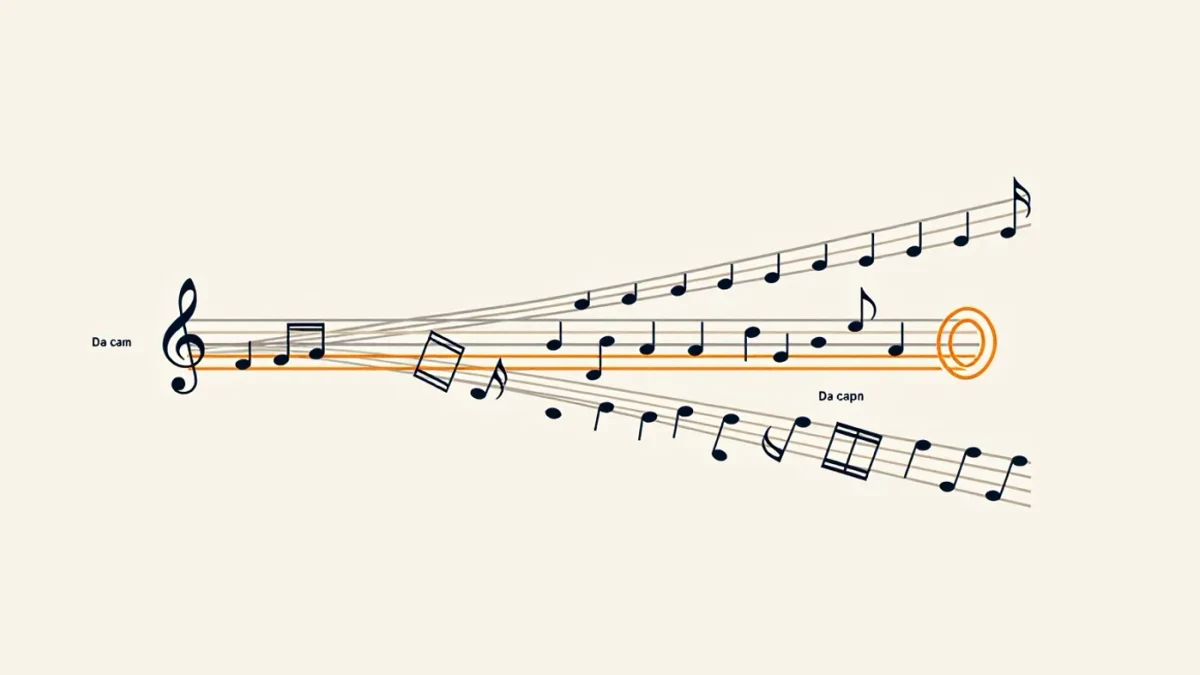
Because a form built on new material gathers no memory. Variation form works by recognition: the listener must be able to sense, even half-consciously, that variation 25 of the Goldbergs is the same sarabande that opened the piece, now stretched into a gigue with hands crossing at speed. The return is the story. In narrative terms, this is the recurring character who enters each chapter older and changed — the theme is the name, the variation is what time has done to it. Musicologists point out that Bach framed his 30 variations with the aria's return at the end, da capo, so the piece closes on the same notes it began with; after everything that has happened in between, those notes no longer mean what they meant. A protagonist who comes home at the end of a novel carries the same effect.
The form also enforces an economy that pure storytelling rarely attempts. Every variation must be traceable to the theme's bass line, its harmonic skeleton, or its melodic contour — one of the three, or the game is lost. The 19th century made that discipline explicit. When the publisher and composer Anton Diabelli sent his simple waltz to some fifty composers in 1819, asking each for one variation, Beethoven initially dismissed the tune as trivial, then spent years producing 33 variations of his own; the result, the Diabelli Variations Op. 120, completed in 1823, is the form's most notorious proof that a modest premise can carry a monumental plot.
How do variations mirror the way a plot develops?
A plot moves by escalation and reversal, and the variation cycle supplies both. The typical plan — a few variations establishing the theme's possibilities, a slow minor-key variation near the end, a build to a fast, often dance-like finale — maps cleanly onto a three-act shape. Brahms's Variations on a Theme of Haydn Op. 56a, premiered in 1873, runs eight variations and a closing passacaglia finale; the theme, a chorale-like tune Brahms took from a field melody then attributed to Haydn, stays audible throughout while the character around it shifts from pastoral to stern to, at the last, processional. A screenwriter would call the finale an act-three payoff: everything the theme learned across the cycle arrives at once.
The minor-key variation deserves its own paragraph, because it is where music and narrative most obviously share a mechanism. Placement matters more than material. In Beethoven's cycle the C minor variation that falls near the end works as the plot's darkest hour — the moment the story confronts loss before the resolution. Benjamin Britten used the same architecture for explicitly narrative ends in The Young Person's Guide to the Orchestra, composed in 1946 on a hornpipe theme by Henry Purcell: thirteen variations, one per instrument, followed by a fugue in which the theme returns beneath the new counter-subject, both sounding at once. The piece was written to teach orchestral timbre to young listeners, and it teaches plotting at the same time — each variation is a scene from the same story told by a different narrator.
What happens when the theme stands for a person?
Edward Elgar's Enigma Variations, premiered in London on June 19, 1899, under conductor Hans Richter, made the mapping literal: each of its fourteen variations carries initials or a nickname naming a friend of the composer, and the variation is a portrait — the variation called Nimrod, standing for the publisher August Jaeger, became the work's best-known minutes entirely as characterization, a slow build from quiet to full orchestra that reads as a temperament. The finale, E.D.U., is Elgar himself. The form's premise — one theme, many identities — becomes a cast list, and the piece behaves like a novel told in fourteen chapters, each chapter a person.
Film scoring inherited the logic without the label. A leitmotif is a theme awaiting its variations, and a score's arc is measured by how far the composer lets the theme travel from its first statement. When a love theme returns in the final reel, slowed and re-orchestrated for strings after having been played bright and quick earlier, the audience hears a relationship's whole history in one passage — the same recognition the Goldbergs audience is asked to perform at the da capo. Composers of game scores push the idea further, writing layered variations that swap in and out depending on the player's situation, so the theme's current variation becomes a running report on the story's state.
Where does the form's storytelling power actually come from?
From the tension between what stays and what changes, which is also the working definition of character. A theme that never varied would be a loop, not a story; a piece of endlessly new material would be a catalogue. The variation cycle promises the listener both anchors and surprise, and it keeps the promise within strict bounds — the same promise a well-plotted novel makes when it reintroduces a known figure in changed circumstances. Scholars of the form, working from primary sources such as the composer manuscripts preserved in collections like the Moldenhauer Archives at the Library of Congress, which holds holograph materials by Beethoven and Brahms among some 3,500 items, tend to describe the form as a negotiation between memory and invention. That description fits any story worth finishing.
Can a listener follow the plot without training?
Yes, and the listening order matters less than the listening habit. Three anchors carry most of the experience: the opening statement, which fixes the theme in memory; the slowest and the fastest variations, which mark the cycle's emotional poles; and the return, if the composer writes one. A practical sequence for the Goldbergs — aria, variation 25 (the long Adagio that the harpsichordist Wanda Landowska famously called the black pearl of the set), variation 29, aria again — takes under twenty minutes and delivers the full dramatic arc. The same three-point skeleton works for the Diabelli and for the Enigma: first statement, darkest or boldest variation, close.
What the form finally offers a story-driven listener is proof that repetition is not the enemy of surprise. The aria at the end of the Goldberg Variations is note-for-note the aria at the beginning — Bach changed nothing, and it sounds changed anyway. Elgar signed his own finale with his wife's nickname for him, E.D.U., and closed a set of portraits of friends with a portrait of the man who wrote them. On June 19, 1899, the London audience heard the theme one last time and understood who it had been about all along.