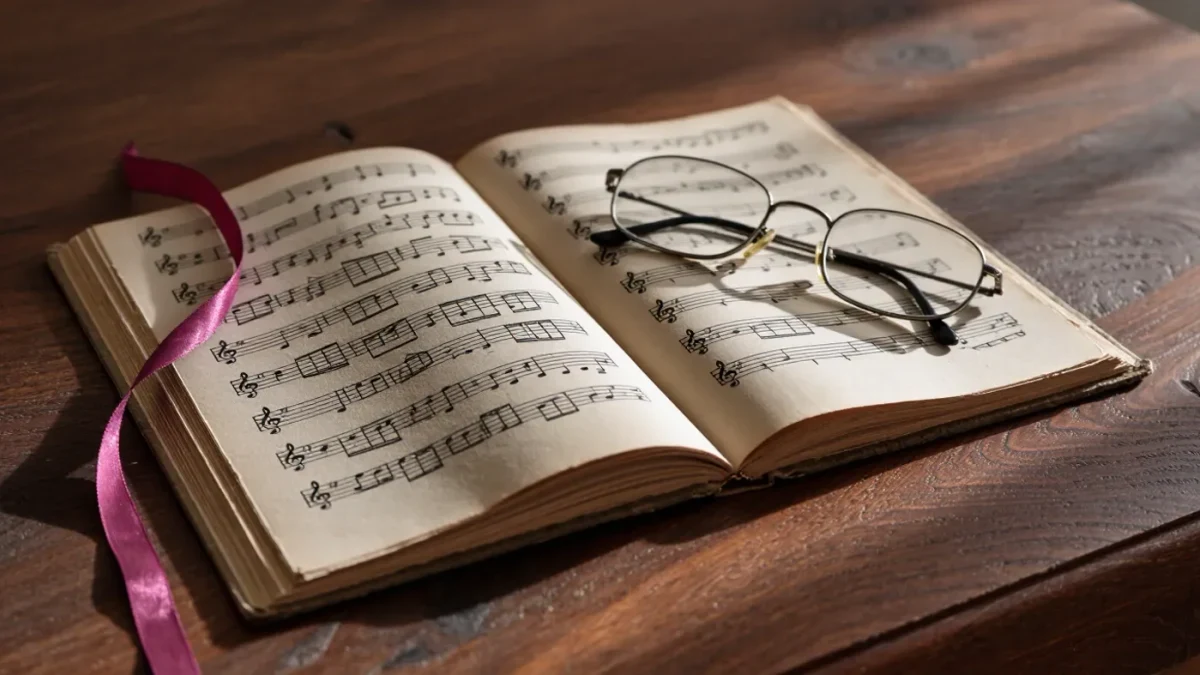
A printed score is the composer's text made visible: pitch placed on five lines, time moving left to right, volume and speed written in as instructions, the whole story of a piece held in a document a non-player can learn to follow. Modern staff notation has carried music on paper for roughly a thousand years, since the eleventh-century theorist Guido of Arezzo fixed pitches on lines in a way readers anywhere could reproduce.
Treating a score as a book rather than a set of playing instructions changes what reading means. Nobody hears a page. But a reader can see the shape of a piece — where it thickens, where one instrument falls silent, where a melody climbs for a page and drops — and that visible shape is the same narrative architecture a listener tracks by ear.
What is actually on the page?
The staff is the ground layer: five horizontal lines, with pitch rising upward, clefs at the left edge telling the reader which line means which note. A full orchestral score stacks one staff per instrument — flutes at the top, strings at the bottom, in a conventional order that has held since the nineteenth century — and aligns them vertically in time, so that a column read top to bottom is one moment of the whole ensemble, and a line read left to right is one instrument's sentence.
Above and between the staves sit the directions. Key signatures define the harmonic home; time signatures state how beats group; bar lines fence the flow into measurable units. None of this is decoration. Each mark is a piece of information the composer or editor placed deliberately, and a reader who learns only these basics can already answer the most narrative questions a score holds: who is playing, who is silent, and how long anything lasts.
Then come the numbers — rehearsal letters or bar numbers scattered through the edition — which function like chapter marks, letting performers and readers find the same place in a story at speed. A conductor's "from letter C" is a page reference in a book whose pages are seconds.
How do the marks work like stage directions?
Dynamic marks are the score's volume instructions: p for soft, f for loud, and their compounds and modifiers, placed exactly where the level changes. Tempo words — allegro, adagio and their descendants — set pace at the head of sections, often with metronome figures. Articulation marks, the small strokes and dots above notes, say whether a note is sustained, detached, accented, or struck.
Read together, these form a running commentary on the music's dramatic register, closer to a playwright's marginal notes than to anything acoustic. A page where a melody marked pp in the violins sits under a sustained f in the brass is a page staging a confrontation; the reader sees the tension in the letters before any ensemble plays it. This is the sense in which notation is a narrative document: the instructions encode drama, not just sound.
Some marks even carry a speaker's identity. Orchestration assigns lines to characters — a solo oboe's phrase set against the mass of strings reads like dialogue against a crowd — and changes of key shift the ground under the story in ways a reader can track by the accidentals accumulating in the signature. A reader who follows a melody through three key changes has followed a plot point, silently.
Can a reader follow a score without playing an instrument?
Yes, and the method is older than recording. Before phonographs, score-reading at home — following symphonies and operas on paper, at the piano or silently — was ordinary musical literacy, and practice survives today among listeners who open a score alongside a recording. The habit is straightforward: read bar by bar, one line at a time, with a finger on the page and the performance as the audiobook. The first passes will lose most of the detail; that is expected. A reader following one instrument's line through a whole movement learns more about the piece's construction than a hundred casual listens supply.
Miniature or study scores — full scores printed small and cheaply, a publishing format established in the nineteenth century for exactly this readership — remain the entry point. They fit on a desk beside the headphones, need no instrument, and assume a reader rather than a performer. For readers who want narrative music to follow, song cycles and ballet scores reward score-reading earliest, because their stories are explicit: the sung text or the scene list sits on the page with the notes, a plot printed above its own soundtrack.
What did the page evolve from?
The story notation tells about itself is one of increasing precision. Early medieval neumes — small signs above Latin text indicating the rise and fall of a chant — preserved contour but not exact pitch, a memory aid for singers who already knew the tune. Guido of Arezzo's eleventh-century innovation of fixing pitches on a lined staff made melody legible to someone who had never heard it, an achievement contemporary accounts credit with transforming how music traveled between regions. Rhythmic precision followed centuries later, as measured notation developed for the multipart music of the late Middle Ages and Renaissance. Every mark on a modern score is a settlement of one of those old problems: what pitch, how long, how loud, and in what order.
Reading the page with that history in mind, the score stops looking like a machine manual and starts looking like a manuscript in a long tradition of writing sound down — the composer's text, edited and printed, holding its story in suspended silence until a reader or a room of players opens it.
Where can a reader find scores to read?
Public collections are the simplest start. The Library of Congress's digital collections offer digitized scores and manuscript material readable online, from hymnals to orchestral works, alongside the provenance notes that tell where each copy came from. Public libraries increasingly license large digitized score databases for cardholders. And printed study scores of the standard repertory remain in print from several publishers at prices comparable to a paperback.
A reader who takes one score and one recording — a Schubert song cycle, say, its German text and its piano line on facing systems — and follows them together to the end, has done the thing this piece describes. The last page of Winterreise in print shows a single drone-like figure repeating under the singer's final questions, the hurdy-gurdy man still grinding as the notes thin out: a story's ending, visible on paper, exactly where Schubert left it in 1827.