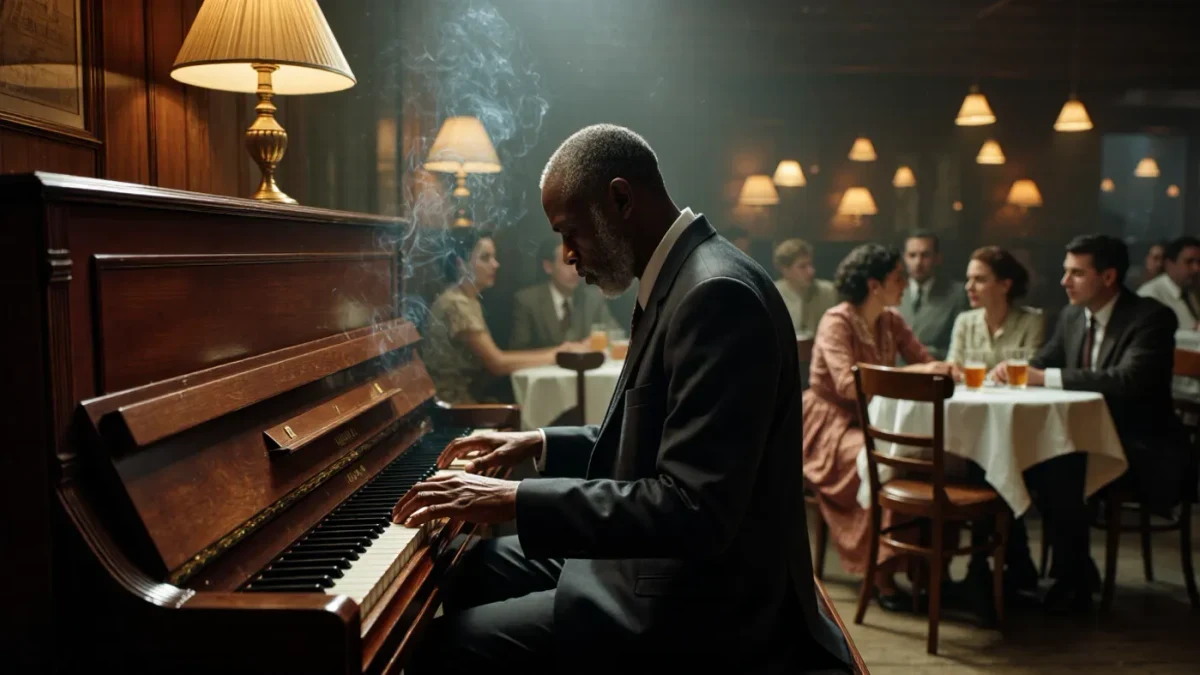
Diegetic music is music that belongs to the story world: a pianist playing in the room, a radio the characters can switch off. Non-diegetic music is the unseen orchestra, heard by the audience and no one on screen. In Casablanca (1942), when Dooley Wilson's Sam plays "As Time Goes By" at Rick's piano, the film uses the first kind; John Williams's two-note motif in Jaws (1975) is the second.
What counts as diegetic music?
Diegetic music is any music whose source exists inside the story: a singer on a cabaret stage, a dance band at a wedding, a phonograph in the corner of a room. The industry term for it is source music, and it does work that the score cannot. Because the characters hear it, it becomes an event in their lives rather than a comment on their lives. When Sam plays "As Time Goes By" — a song Herman Hupfeld wrote in 1931, a decade before the film — the tune is not atmosphere. It is evidence. It is the shared past that Rick and Ilsa cannot say out loud, played where everyone in the café can hear it and only two of them understand.
The test is simple and worth memorizing: can a character, in principle, turn it off? If the answer is yes, the music is diegetic. A marching band passing in the street qualifies. So does a villain humming to himself, a music box, a concert pianist mid-recital. What matters is not volume or style but address — which world the sound is speaking from.
Who decided the characters cannot hear the score?
Nobody decided it all at once; the convention hardened along with sound film itself in the early 1930s. The vocabulary came later. Film theorists in France in the 1950s adapted the old Greek word for a narrated world, diegesis, to describe everything that exists inside a film's story — its places, its people, its sounds. From that noun, film-sound studies derived the pair at the center of this piece: diegetic, inside the story world; non-diegetic, outside it, addressed only to the audience.
The distinction matters because the unseen orchestra carries a different kind of authority. Bernard Herrmann's shrieking strings in the shower scene of Psycho (1960) terrify precisely because no one in the Bates Motel hears them. The music knows something the characters do not. That is the basic contract of non-diegetic scoring: the music sits on the audience's side of the glass, free to foreshadow, mourn, and accuse without ever being noticed by the people on screen.
What happens when the two layers trade places?
The most quoted moments in film scoring are the ones where the border itself becomes the device. Composers and picture editors call the crossing a metaleptic shift, and it works because the audience has been trained by hundreds of films to keep the two floors separate. When a film breaks the wall between them — a source song swells into a full orchestra no band on screen could contain, or the score suddenly plays from a radio in the corner — the viewer feels the ground move.
Casablanca already understood this in 1942. The piano version of "As Time Goes By" is diegetic, but the film repeatedly lets the tune hand itself up to an unseen orchestra, which carries the melody into scenes where no piano could plausibly sit. The song starts as an object in the room and ends as the characters' inner weather. Watch the Paris flashback sequence and the handoff is visible: source music becomes score without a seam the ear can locate, which is exactly the point.
Related stories: Two Names, Two Jobs: the music supervisor vs composer question, settled by the credits · Music That Listens Back: why video game scores tell stories no film can.
Why do directors choose one layer over the other?
Each floor buys something. Source music buys realism and dramatic irony at once: it dates a scene, places it socially, and lets characters lie about their reactions to a song everyone present hears. Scoring buys interiority and time — the ability to stretch four seconds of a glance into eight, to tell the audience what a frozen face conceals. Williams's Jaws motif, which won the Academy Award for Original Score at the 1976 ceremony, is the textbook case: the shark is barely seen for most of the film, so the non-diegetic music becomes the animal. Two notes, played where no swimmer can hear them, and the water changes.
The choice is made cue by cue, usually at the spotting session, where director and composer decide what gets music and what does not. A common and under-discussed decision is silence: declining both floors, letting scene noise carry a moment, so that the next entry of music — from either floor — lands with weight.
Does television play by the same rules?
Television inherits the two floors but adds a third variable: repetition across episodes. A theme song can be diegetic in its first appearance — performed by a character in a club — and then return, episode after episode, as pure underscore attached to that character's scenes, a leitmotif that has changed floors permanently. The technique is a legacy of radio drama, where producers had no image to lean on and learned to signal place, time, and danger through music whose source was sometimes named in the dialogue and sometimes not. Serialized scoring also economizes: a cue written for one episode's death scene can be re-orchestrated for another episode's aftermath, and the audience reads the quotation as memory. The border between the floors, crossed once deliberately, becomes a place the show can revisit.
Streaming-era serialization has made the trick subtler still. With whole seasons released at once, composers report in interviews and liner notes that they score arcs rather than episodes, holding back a theme's fullest statement until a later hour so that its arrival feels earned. The two-floor vocabulary survives intact; what changes is the clock the crossing is timed against — not a single evening but a weekend of viewing.
How can a viewer train an ear for the split?
Start with musicals, the genre that lives most openly on the border. In Singin' in the Rain (1952), the numbers performed on stages and soundstages within the story are diegetic by construction, while the famous title number drifts into a middle territory the musical has always owned, where the street itself seems to orchestrate a downpour. Then run a thriller with the question in mind: Jaws for pure non-diegetic dread, Psycho for strings that behave like a Greek chorus with knives.
- Ask where the speakers are. If the film could point at them, the cue is diegetic.
- Watch for handoffs — a source tune that blooms into orchestration no on-screen ensemble is playing.
- Notice what the music knows. If it grieves before a character dies on screen, it is speaking to the audience alone.
Once the habit forms, the two floors stop being trivia and become structure. A viewer who can hear the split can also hear when a film deliberately muddles it — when a song on a radio keeps playing after the radio is smashed, or a score falls silent at the worst possible moment. Those are not accidents. They are the staircase between the floors being used as a storytelling instrument, which is what the best film music has been doing since Sam first sat down at the piano in 1942.