On a film score, the composer writes the music — the themes, the harmonies, the decisions about what a scene needs — while the orchestrator turns those decisions into parts every orchestral musician can play, and the copyist prepares those parts for the stand. Three jobs, three credit lines, and a division of labor that has quietly shaped the sound of cinema since the studio era.
The distinction matters because the credits are the only public record of who did what. Read exactly, a card that says "music by" one name and "orchestrated by" several names is telling a precise story about how a score was built — and about a craft hierarchy that most viewers have never had reason to parse.
What does the composer actually deliver?
The composer's deliverable is the musical substance: melody, harmony, rhythm, form, and timing to picture. On a modern production that usually means a sketch — sometimes a fully notated short score of two or three staves, sometimes a digital mock-up in a sequencing program whose audio, approved by the director, becomes the reference for everything downstream. The composer also makes the narrative decisions this publication exists to follow: where a cue starts and stops, whether a theme enters openly or disguised, which scene gets silence instead of strings.
In the classical world the same figure would write every note of the finished orchestration. Film works at a speed that makes that rare. A feature can carry two hours of music, written, revised and recorded inside a few weeks of post-production, which is why the composer's sketches — however detailed — hand off to a music department for the expansion into full orchestral score.
Some film composers have orchestrated their own work, and a credit reading "composed and orchestrated by" signals exactly that. It is a slower path, chosen on schedules that allow it, and it is not the industry's default. The default is the division.
What does an orchestrator add?
The orchestrator's task is translation. Starting from the composer's sketch or mock-up, the orchestrator assigns notes to instruments: which line goes to the violas and which to the cellos, where the horns double the melody an octave below, how a chord voiced in a keyboard demo becomes a spacing that works for fifty players breathing together. The work demands encyclopedic knowledge of ranges, transpositions, and the physics of ensembles — what carries over a brass section, what disappears inside one.
Translation is not authorship, and the profession's own understanding of the line is stricter than the folklore. An orchestrator who imposed a new theme or a different harmonic plan would not be orchestrating; the job's discipline is to realize someone else's decisions with maximum fidelity and instrumental intelligence. The best orchestrators are prized precisely for sounding like the composer they serve — for a signature that is, by design, invisible.
That invisibility is why the role is so often misunderstood. A century of screen credits has listed orchestrators in smaller type than composers, on the accurate theory that the music's identity belongs to whoever conceived it. The unfairness is not the credit line itself but the assumption, common outside the industry, that "orchestrator" is a euphemism for ghostwriter. The professions have a name for actual ghostwriting, and it is a scandal when it surfaces — because it violates the exact credit system both crafts depend on.
What does the rest of the music department do?
After orchestration comes music preparation. The copyist — a title that survives from handwritten craft even though the work is now digital — produces the individual parts, one for each player, error-free and page-turned sensibly, from the full score. A single mis-copied accidental can cost a room of union musicians several minutes of expensive session time, so preparation is checked, proofed, and checked again before the downbeat.
Around these three roles sits the rest of the machinery the credits also name: the music editor, who keeps score and cut in sync as the edit changes; the music supervisor, who selects licensed songs and clears the rights; the contractor, who hires the orchestra. Each is a distinct credited craft, and none of them is the composer's job — which is why a screenplay-style crawl of music credits on a modern film can run a dozen names before the orchestra begins.
Why hasn't software dissolved the division?
Notation programs can now print playable parts directly from a composer's file, and many working composers produce finished scores without a separate orchestrator on smaller projects. The division persists on larger ones for the reasons it appeared: time, and the value of a second expert brain on instrumental detail. A composer writing to a locked cut in three weeks gains more from delegating the expansion than from controlling every fingering; the orchestrator, working from clear sketches, can move faster than any single person writing and preparing two hours of music alone.
Scale decides the answer more than philosophy does. A four-cue independent film with a twelve-piece ensemble may pass from the composer's file to the players' stands with no orchestrator credited at all; a fantasy epic carrying a hundred minutes of music for a ninety-piece orchestra may keep a team of orchestrators occupied for the length of post-production. The credit block reflects that arithmetic rather than the composer's seriousness, which is why the same name can appear one year beside "composed and orchestrated by" and the next above a list of five collaborators.
The studio era built the system deliberately. Factory-scale music departments kept staff orchestrators and copyists on payroll so that a composer could deliver sketches at the pace the production demanded. The departments dissolved long ago, but the workflow they standardized — sketch, orchestrate, prepare, record — is still the shape of a scoring week, freelance rather than staff.
For audiences, the practical takeaway is a reading habit. On the next film's end credits, find the music block and read it as a diagram of labor: the composer named first and alone; the orchestrators next, in the plural; the music preparation firm after that. Each line answers the same question this piece began with — who actually writes a film score — and the answer, honest and structural, is that a score is written in stages by specialists whose names are printed in descending order of authorship. Context on how that credit culture reads today appears in mainstream film-music coverage, including BBC Culture's arts pages.
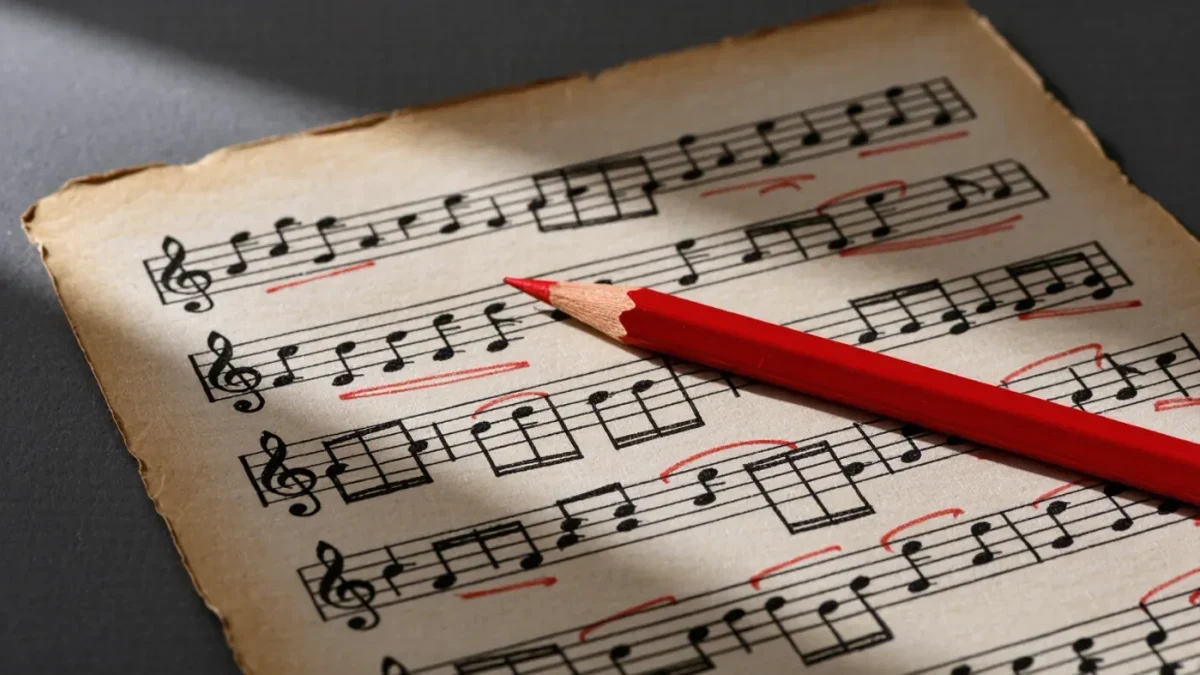
The oldest document of the divide is the sketch itself. Archived film-music sketches — short scores in a composer's hand, expanded elsewhere into full scores in another's — survive in research collections; the Library of Congress's digital collections preserve such manuscript material, two hands visible on one body of work, the division of labor written down.