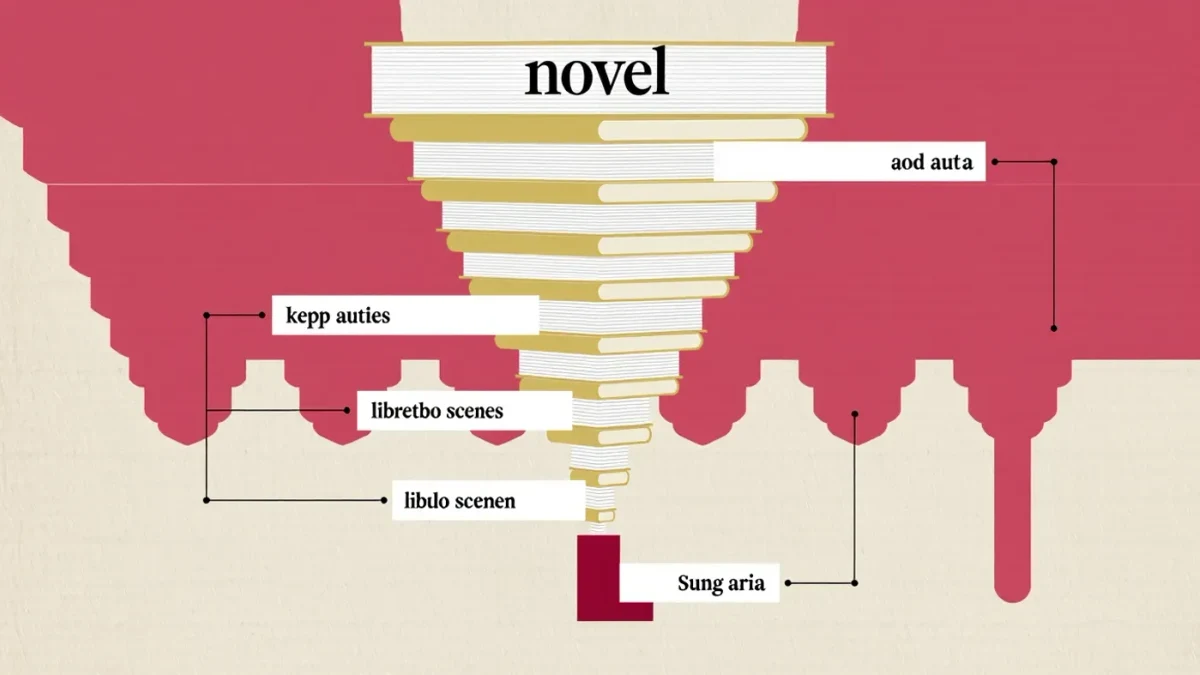
A novel becomes an opera by losing most of itself on purpose: Puccini's "La bohème" (1896) keeps only a handful of episodes from Henry Murger's episodic book "Scènes de la vie de bohème" (1851), compressing a sprawling sketch of Parisian garret life into four compact acts of chosen moments. The libretto, by Luigi Illica and Giuseppe Giacosa, is not a summary of Murger but a selection from him, and that act of selection, brutal and editorial, is the first law of the form. Few novels survive the passage intact, and the ones that do were usually already short.
Why can't an opera tell a novel's whole story?
Time. A sung line takes far longer than a read one, and a three-hour opera holds roughly the dramatic content of a short play. Every adaptation therefore begins with triage: the librettist and composer identify two or three irreversible turns in the book and discard nearly everything else, including most of what novel readers cherish, the digressions, the interior monologue, the weather. What cannot be spoken at length must be implied in a chord or compressed into a line, and much of the art of opera libretti is the art of what a single sentence can be made to carry.
Interiority is the specific casualty. A novel lives inside its characters' heads; an opera lives in what characters can sing to each other, and to a hall. Librettists therefore convert thought into action, turning reflection into confrontation, so that a heroine's private grief must become an aria sung at the world. Paradoxically the loss produces one of opera's genuine gains: where a novel can say a character is devastated, an opera can make devastation last four unbroken minutes of voice and orchestra, a duration prose cannot sustain and would not want to.
What does the music add that the page never had?
Simultaneity and memory. An orchestra can accompany a character's self-deception with harmony that contradicts the vocal line, letting the audience hear the lie from inside the scene, and a returning theme can quote a dead character or a lost happiness without a word being spoken. This is the craft the site has examined before in other media, the recurring motif bound to a person or idea, and opera is where it was systematized. When the heroine of an adaptation sings a theme the audience last heard in the first act, the book's back story returns as pure sound, instantly and without exposition.
Alban Berg's "Wozzeck" (1925), built from Georg Büchner's unfinished 1836 play rather than a novel, shows the method at full power: the score is organized as strict instrumental structures, scenes shaped as passacaglia and suite, so that the story's fatalism is written into musical architecture the listener feels rather than sees. Literature with that kind of compressed, image-driven writing adapts well precisely because it is already stripped; Büchner gave Berg a skeleton, and Berg clothed it.
How do adapters handle a novel's scale?
They either compress hard or split the work into parts. Poul Ruders's "The Handmaid's Tale," which premiered at the Royal Danish Opera in Copenhagen in 2000 with a libretto by Paul Bentley after Margaret Atwood's 1985 novel, keeps the book's first-person frame by other means, letting the narration survive as sung commentary; Atwood herself had a documented hand in the production's journey to the stage and the work has since been staged by major houses. Jake Heggie's "Dead Man Walking" (2000), with a libretto by Terrence McNally after Sister Helen Prejean's 1993 memoir, made the opposite choice, paring a discursive nonfiction book to a single relationship under a deadline, and it has become one of the most performed new operas in the United States since its San Francisco Opera premiere.
Novels of genuine vastness tend to become opera cycles or musicals rather than single evenings. Victor Hugo's "Les Misérables" (1862) reached the musical stage through Claude-Michel Schönberg and Alain Boublil's score, first in Paris in 1980 and then in the 1985 London production, and even at nearly three hours it keeps only a few threads of Hugo's thousand-page chronicle. The adapter's honest answer to a big book is that the book must be quoted, not contained; audiences get the novel's turning points with music grafted on, and the novel itself remains the only complete telling.
Who decides what gets kept, the composer or the librettist?
In theory the librettist shapes the words and the composer shapes everything else; in practice the boundary moves with every collaboration. A composer who thinks in large spans, as Berg did, may ask for scenes that can support strict musical architecture, while a librettist protecting a book's irony may refuse the broad emotional beats that sing best. The surviving correspondence of major collaborations shows constant negotiation over length, repetition and how plainly a turning point may be stated, because a line that is sung three times is not padding in opera but emphasis, a device prose uses sparingly and music uses structurally.
The decisions also have a physics of the voice behind them. Vowels sustain and consonants do not, so a librettist writing for high soprano favors open Italianate sounds and avoids clusters that vanish at the top of the staff; a character's most important word must be singable at the moment of greatest strain. This is why adapted dialogue rarely survives verbatim from the page. The book's sentence is rebuilt around the instrument that must deliver it, and what the audience recognizes as the novel's voice is often the composer's setting of a line the novelist never wrote.
Why do some adaptations outlive their sources in the public mind?
Repetition and theatercraft. The opera house revives what works on its own terms, regardless of the book's standing, so "La bohème" long ago eclipsed Murger's book in general memory, and the musical of "Les Misérables" functions for many as the primary text. An adaptation that finds a musical solution to the book's emotional core can replace the original in the culture's working knowledge, which is why adapters argue so fiercely over what the core is.
The traffic runs both ways, and lately faster in the direction of new material: houses commissioning works from films, memoirs and headlines, a trend the BBC's arts desk was already charting in 2013 around Mark-Anthony Turnage's "Anna Nicole" at the Royal Opera House. Whatever the source, the discipline stays the same one Murger's adapters obeyed in the 1890s. Find the two or three turns that cannot be cut, translate thought into song, let the orchestra remember what the libretto had to leave out. A novel can afford everything; an opera can afford almost nothing, and out of that poverty it makes the four unbroken minutes that prose cannot have.