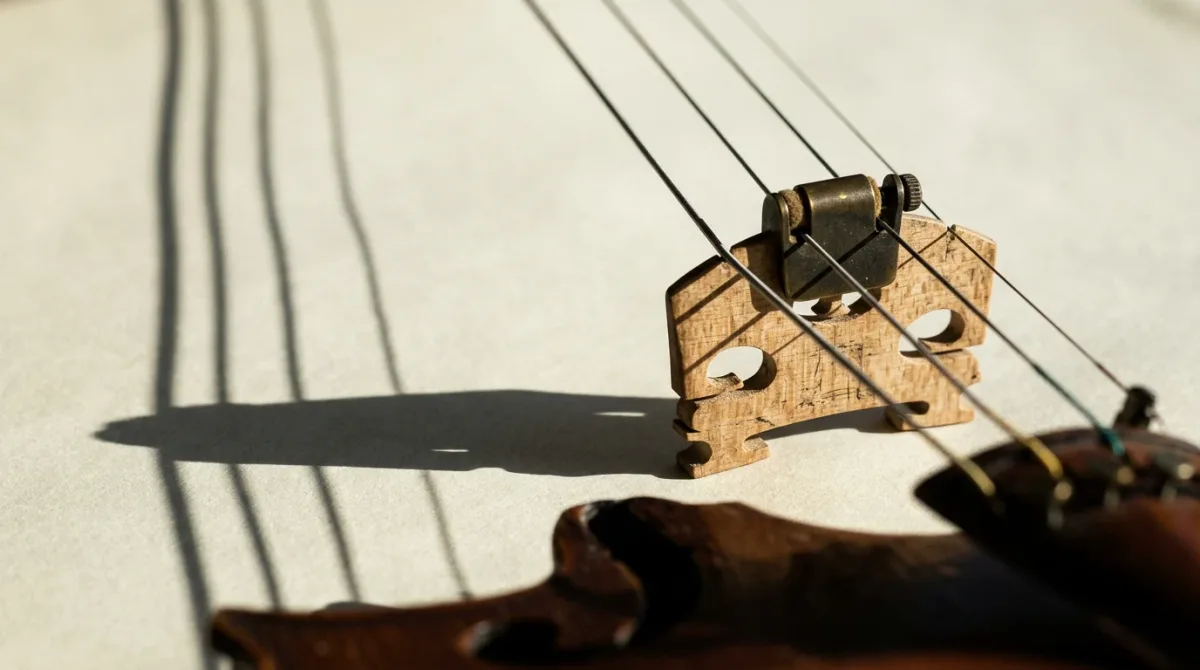
Bernard Herrmann scored Alfred Hitchcock's Psycho (1960) for string orchestra alone — no woodwinds, no brass, no percussion — a restriction he characterised as a black-and-white score to sit alongside the film's black-and-white photography, according to NPR's account of the music. Every effect the score is famous for is produced by bowed strings and nothing else.
That constraint is unusual enough to be worth stating plainly before anything else, because almost every popular description of this music reaches for the murder cue and stops there. A cue is a single continuous piece of music written to a specific stretch of picture, and Psycho contains dozens of them. The string-only rule governs all of them, not just the one everybody can hum.
| Field | Detail |
|---|---|
| Work | Psycho (1960), directed by Alfred Hitchcock |
| Composer | Bernard Herrmann (composer; born 29 June 1911, per CBS News) |
| Instrumentation | String orchestra only |
| Concert editions | Psycho: A Short Suite for String Orchestra, ed. Christopher Palmer, 7 minutes; Psycho: A Narrative for String Orchestra, ed. John Mauceri, 15 minutes 35 seconds — both listed by Wise Music Classical |
| Complete re-recording | Psycho (The Complete Original Motion Picture Score), Joel McNeely conducting the Royal Scottish National Orchestra, 1997, 40 tracks |
| Basis of coverage | SRC-01 to SRC-06, listed in the source notes |
Why did Herrmann restrict himself to strings?
The documented reason is a visual one. NPR's 2000 segment on the score reports that Herrmann conceived the music as a black-and-white score to match the film's photography, and that he asked the players for mutes and for percussive attacks that strings do not usually supply. A mute is a small clamp fitted to the bridge of the instrument; it thins the tone and drains the warmth out of it, which is why a muted string section can sound closer to breath than to song.
Nothing in the sourced record connects that choice to the film's economics, and it is worth resisting the temptation to join the two. The film was made quickly and cheaply — it cost $800,000, and Hitchcock used the crew from his television series Alfred Hitchcock Presents, as critic Charles Taylor writes in the essay held by the Library of Congress. Those are facts about the production, not an explanation of the orchestration. Herrmann's own stated reason, as reported, was chromatic.
What happened with the murder cue?
Hitchcock did not originally want music there at all. NPR's segment recounts that the director intended the sequence to run on screams and knife sounds alone, that Herrmann wrote a cue for it regardless, and that Hitchcock afterwards conceded the point — telling the composer, in the exchange the segment quotes, "Improper suggestion, my boy."
The cue is the one piece of this score most listeners can reproduce from memory, and the account above is the version of its origin that a named outlet has published; it is not a studio anecdote and should not be traded as one. What can be said about the music itself without leaving the evidence is narrow and durable: it is played by the same string section as everything else in the film, with the same equipment, and it arrives after long stretches in which the score has been withholding exactly that kind of attack.
Is the album the same as the score in the film?
No, and the distinction matters more here than for most scores. What is heard in the 1960 film is the recording made for the film. The widely circulated complete version is a separate object: Psycho (The Complete Original Motion Picture Score), a 1997 re-recording conducted by Joel McNeely with the Royal Scottish National Orchestra, running forty tracks and just over an hour. NPR's segment used that recording for its illustrations rather than the film's own audio.
A re-recording is a performance of the written score by other musicians under another conductor, decades later, in a different hall. It can be more complete than the film — a film mix buries cues under dialogue and effects, and cuts them to picture — while remaining a document of the notes rather than of the soundtrack as an audience first met it. Both are legitimate ways to hear Psycho. They are not interchangeable, and a piece that treats them as one thing is describing something that does not exist.
What did the score become after the film?
It became printed concert music, twice, in two different shapes. Wise Music Classical lists a short suite for string orchestra edited by Christopher Palmer, seven minutes long, in three movements: Prelude, The Murder, Finale. The same publisher lists a considerably larger work, Psycho: A Narrative for String Orchestra, edited by John Mauceri, at fifteen minutes and thirty-five seconds, in seven sections — Prelude, The Madhouse, The Murder, The Water, The Swamp, The Stairs, The Knife and The Cellar, and Finale.
The publisher's entry for the Mauceri edition describes it as a restoration from a Herrmann manuscript of 1968, in which the composer had already worked several film cues into a single continuous piece rather than a suite of detachable numbers. That is a meaningful difference in kind. A suite anthologises; a narrative runs. Anyone programming the music has to decide which of the two objects the concert is for, and the running times alone declare that they are not the same commitment.
How has the score been recognised?
Unevenly, and slowly. The score received no Academy Award nomination, as NPR notes — a fact that has outlived most of what was nominated that year. The film itself was added to the National Film Registry in 1992, thirty-two years after release. Wise Music Classical's catalogue entry records that the music was placed fourth on the American Film Institute's list of film scores.
The string-only rule also reads differently against the rest of the catalogue. Morgan's CBS News piece places Psycho among scores that include Citizen Kane, Vertigo and Taxi Driver, and notes that Herrmann worked in radio with Orson Welles on Mercury Theatre on the Air and wrote for Rod Serling's The Twilight Zone, alongside films for François Truffaut, Brian De Palma and Martin Scorsese. A composer with that range chose, for one picture, to give up most of the orchestra. The restriction was an option exercised, not a limit imposed.
Herrmann's standing among later composers is documented in the same NPR segment, where Danny Elfman describes him as having "always been my model and my idol." The relationship with Hitchcock did not end well: in a CBS News centenary appreciation published on 28 July 2011, David Morgan describes Herrmann as fiery and temperamental, and writes that his refusal to supply pop material aimed at record sales led to his dismissal by the director.
The object that survives all of this is not the film print and not the album. It is a manuscript dated 1968, eight years after the picture opened, in which Herrmann took the cues back from the screen and rewrote them to run continuously — the source John Mauceri worked from, and the version a string orchestra plays when there is nothing to look at.
For a related business news perspective, read The Cue Sheet: the paperwork that decides who gets paid for a film score.